
I know I'm a week late, but still, I didn't want to miss the opportunity to tell you a little something about one of Mexico's most beautiful and important celebrations: el "Día de Muertos", which is a big deal all around the country, but can be best experienced in the state of Michoacan (especially in rural areas).
There are many celebrations of the Catholic world that people in Mexico adopt as their own, and by doing so, they are “mexicanized”, but there is no celebration as especial as The Day of the Dead.
This unique celebration has been created as a mixture of two worlds: the pre-Hispanic world and the Catholic word of the Spaniards. But, how did this happen? Here I will try to explain the facts that led to this creation, the way this festivity was carried out in the past and its contrast with the way it’s celebrated in the present time.
I will also have the chance to show you some of the nice pictures I took while walking through Downtown Morelia on the Day of the Death weekend.
"Las Tarascas" fountain decorated for the Day of the Death celebration
Origins of the Day of the Dead
As I said, “Día de Muertos” is one of the most important celebrations in Mexico, especially in rural areas. Its importance could only be compared with the festivals celebrated in honor of the local saints of the towns. These saints are believed by Mexicans as “lesser deities” who intercede with God. In the folk-Catholicism of Mexico, the souls of the departed also have this possibility.
This festivity is mostly a family feast, but it has a public aspect at community level. On this date, the family is reunited. Living and death share a few time together once a year. Although this might seem scary, it is the contrary.
The celebration combines elements from the pre-Hispanic religious belief and practice and elements from the Catholic feast. It is this last one which has obscure origins.
In Mesoamerica, the idea of arising out of death was very clear. In their complex religion, the recurrent theme is the interdependency and interaction of the humans with the gods. Also, the belief of an afterlife was present since very early times.
.
It was until the end of the 13th century when the “All Souls” was accepted as a liturgical day. However, it was difficult to incorporate the practice of feasting, as it was a pagan custom.
Christian church tried to refocus the feasting by incorporating festivals for the saints, but the practices associated with the death were strong.
Two of the Aztec festivals, Miccailhuitontli and Micaihuitl (life feast of the death and great feast of the death) are associated with cults of the dead. On these celebrations they used to adorn the figure of Huitzilopochtli with flowers, then, they would feast and dance.
.
Common to the ancient and modern ceremonial connected to dead are the flowers, the offering of food, incense, paper ornaments, dancing, music and cleaning of cemeteries.
.
When the Spaniards tried to incorporate their Christian rituals, Indians couldn’t understand them, so they tried to hold on their customs hiding their symbols and gods within the Christian ones.
What helped the conversion of Indians was the fact that there were a lot of elements that seemed close to Christianity (infant bathing, eating part of the gods, ideas of confession, etc). They had gods that were related to Christianity to (Tezcatlipoca, Huitzilopochtli, Coatlicue and Quetzalcoatl). The saints quickly adopted the place of small gods.
During the colonial period there was a mixture of the commemoration of the dead formed by Spanish and Mesoamerican aspects. Ceremonial fiestas reached a peak of riotous display in the cities that alarm the authorities, so, in 1766 gatherings in the cemetery and the consumption of alcohol was forbidden during the time of “todos los santos”. Indians were not content with this, so eventually, this was changed.
The Celebration
On the first days of November (1st and 2nd), households make offerings of food and drink to the dead. In many places, there is also a feasting in the cemeteries. The Totonac Indians, for example, extend the celebration to 8 of November (octava).
There are days designated to celebrate the different ways of deaths, some say this are hierarchical.
Within the days of “todos los santos”, people clean and decorate the tombs in very creative ways (the cemeteries of Tzintzuntzan are a very clear example). Flowers, candles, incense and crosses are carried there. There is also music-making of all kinds. In some places, the celebration takes place at daytime (Tancoco, Veracruz and Chilac, Puebla, for example). On the other hand, in other places like Michoacán, the visit to the cemetery consists in a nightlong vigil.

The Cemetery of Tzintzuntzan
There are other places, like San Pablito in Puebla, where special masses are made and, if the priest is available, he leads the activities in the cemetery.
The “Ofrenda” (Altars)
Most of this day’s preparations start much earlier in the year. Everything in this festivity is supposed to be new, but sometimes circumstances do not make it possible.
The rural markets are filled with color and excitement because this is where all the things for the offering can be buyed (fruits, vegetables, pottery, flowers, incense, toys, sugar sweets, tissue-papers with punched or cut-out decorative designs, etc.).
The orange color of the “cempaxochitl” (flower of the dead) is predominant, as this is the flower associated with festivals for the dead in pre-Hispanic times. That is why the “ofrendas” often have paths made by its petals, so the dead can find their way to the food and drinks (also to find the way back, so they won’t stay and haunt the living).

Traditional Ofrenda dedicated to Morelos
The preparation of the bread for the dead begin before 30 October and its carried out by men. The cooking of the other food also begins in advance.
The ofrenda is constructed on the 30 or 31 of October bye the whole family. It is usually a table covered with a white cloth or plastic sheeting. It has also an arc made by canes, and decorates with flowers, palms, other green leaves and sugar canes (this may vary). The “papeles picados” are also used to decorate the “ofrenda”. On the table, pictures of the dead ones (in central position), saints and virgins are placed. Candles are very important, the guide the souls of the dead. Before the table, a “petate” will be placed. Finally, the food offering and more flowers are placed on the table.
Return of the Soul
The belief is that the souls of the children are the first to return. Food and gifts appropriated to them are settled. These “little” souls are divided in to: the ones who died before baptism (who return the 30 October) and the other children (31 of October). Then, it’s the adults turn, with more spicy food (mole, tamales, enchiladas, chalupas, etc) and drinks that they preferred (coffee, atole, tequila, mescal, aguardiente, etc.). They arrive on November the 1st.
Clothes and personal possessions are also added to the offering. If they receive new stuff, these will be used by the living, such as it happens with the food. The spirits of the dead do not consume the food, but the spirit of it, so later the family will consume part of it and will distribute the other part with friends and relatives.
In the present time, we find that some “ofrendas” include commercially produced goods. The elaboration and the cost of the ofrendas depend on the family status. Mestizo families sometimes hire experts to build their “ofrendas”.

Traditional Ofrenda from Michoacan
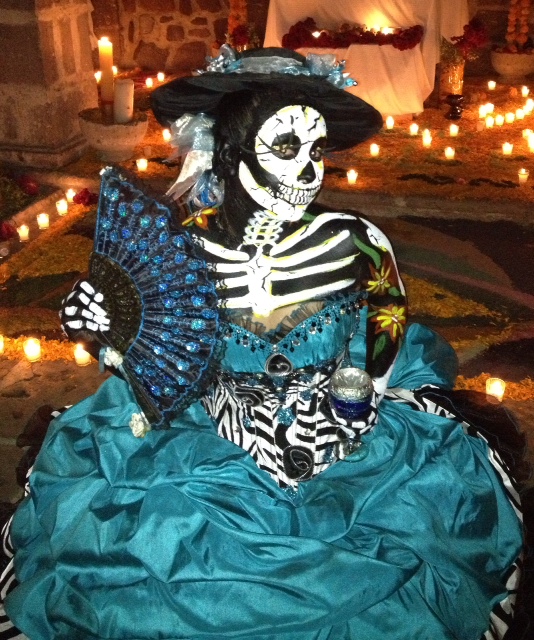
In Mexico City the “ofrendas” are from the traditional way, to only a table with photos, flowers and candles. Skulls and skeletons are found in the urban context. In fact, there are made some skeleton figures in papier mâché in honor of the artist Posada (la Catrina).

Me and a fancy Catrina
Many public buildings make their “ofrendas” (museums, stores, galleries, hotels, etc.).
Fountain of "Jardín de las Rosas" decorated for the Day of the Dead
Now, competitions of “ofrendas” are held all around the country, which make them every year more complex. In Morelia, for example, you can see two competitions: one of the traditional “ofrenda” (the one described above) and the other of modern “ofrendas”. In this last one you can find very original and metaphoric ideas (they tend to be very weird though) which have nothing to do with the traditional “ofrenda”.
Modern Ofrenda dedicated to Alfredo Salce (known artist of Michoacan)
On the present day, the celebration of the day of the dead is becoming more a custom than an obligation, and it has everyday less religious significance. The purpose is to maintain a good relationship with the dead ones.
My friend Juan and me making a new acquaintance
Other Facts
The origin of sugar figurines used in today’s ofrendas appears to be Europe. They also have relationship with the fact that pre-Hispanic used to keep skulls as trophies. Now, new types of skull appear every year in Mexican markets.
On 1840, the urban celebration was deep related with traditions of catholic church (it was kind of gloomy), now, it is more in touch with an atmosphere of joy.
"Mariachi Calavera" in Downtown Morelia
By this festivity and joy environment, it is noticed that Mexicans do not fear death. They cry for their beloved departed ones, but they rejoice as they think they are in a “better place” now and they have the hopes to reunite with them someday.
The images of Calaveras made by José Guadalupe Posada, who mocked the antics of the living, are still present today in the popular imagery (“la Catrina” is internationally recognized).
"Frida", the Catrina who lives in my house
There is a variation of the festivity depending on the region of the country. In fact, in the present time, the feast has crossed the border, as it is now celebrated by Mexicans who live in the U.S. Music, dancing, elaborated costumes, masses and ofrendas are made (though this face an acculturation right now).
I would like to finish by saying that the Day of the Dead has an important place in the hearts of, not only Mexicans, but in every person that has had the opportunity to be part of it. In my opinion, this happens because of the deep meaning that it still keeps, and the big quantity of cultural aspects that are put together (music, food, decorations, etc.).
Calzada Fray Antonio de San Miguel
As some say, “the Day of the Dead is alive” and it has become an essential fact in the preservation of the national identity. That is why I think it is important not to loose the real meaning of this celebration, to keep it the way it is so it won’t disappear.
Me just before taking those beautiful pics of Morelia during the celebration of the Day of the Dead
.
.
by Lil21
.
Source
Carmichael Elizabeth, The Skeleton at the Feast, the Day of the Dead in Mexico, part 1, pp. 14 – 71.

 Her first appearance was in the famous etching called "La Calavera Garbancera" (right), created by the Mexican printmaker José Guadalupe Posada in 1913. Posada wanted to criticize some Mexicans that used to deny their roots and wished to look European and wealthy, but really belonged to a low class. He used to say: ..."en los huesos, pero con sombrero francés con sus plumas de avestruz" (in her bones, but with a French hat with ostrich feathers).


