Showing posts with label Traditions. Show all posts

Wednesday, January 06, 2016

New Year Resolutions


Hello beautiful people! 2016 just started and everywhere around the social networks we pretty much see and read everyone's hopes and goals for this New Year. Moreover, let's face it, we also start seeing how many of them already started failing their acts of self-improvement.

Like many traditions, this one has religious origins from different cultures and time periods. In Babylonia, people used to promise their gods that they would pay all their debts. In ancient Rome, the promises of self-improvement were made to the god Janus (after whom the month January is named). In Medieval times, it was after Christmas when the knights had to renew their chivalry vows. 

In the case of Christianism, the period for good behavior and promises to god, has more to do with Lent, but it still talks about an annual reflection in order to improve oneself.

What is the most popular one? You all know it, weight loss and having a healthier lifestyle. Other popular goals have to do with money, career, social skills, traveling, family (getting married), spiritual world, etc...

This practice is more popular in the Western world, though it is also seen in Eastern cultures. I think it would be very interesting to compare both sides to see differences and similarities in goals.

Personaly, I love the good vibe and feeling surrounding the start of a year which inspires everyone to make resolutions, but I believe that the only way to fulfil your promises is to make them realistic and simple. On that note, of course I didn't escape the resolution list making this year, I just hope I get to fulfill at least one of them.

What is your most important resolution this year? Did you make any creative ones?

Tuesday, November 20, 2012

LA CATRINA, A MEXICAN SKELETON


Some days have passed since the celebration of Day of the Dead, and maybe during those days you heard about this popular Mexican character, and maybe you were wondering about her origins and the reason of her popularity.

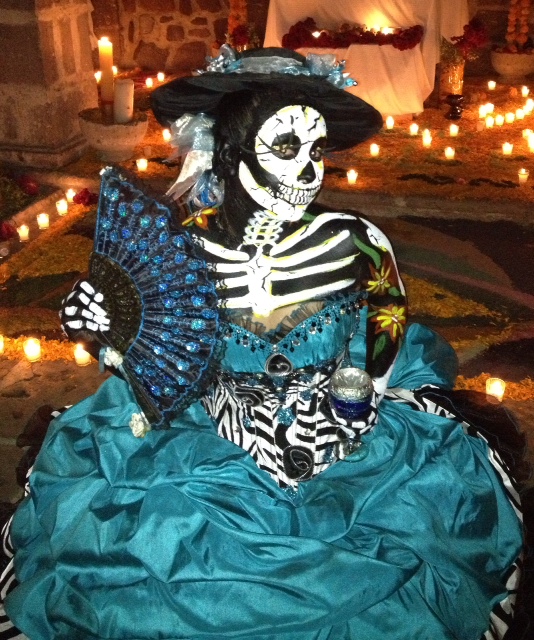
If you haven't really heard from her, la Calavera Catrina is a fancy skeleton lady who wears pretty dresses and elaborate hats (just like the first photo shows). Actually, for many years the Spanish word "catrín" has been used in Mexico to define an elegant or fancy gentleman, in the same way "catrina" is used  to call an upper-class  lady.

Her first appearance was in the famous etching called "La Calavera Garbancera" (right), created by the Mexican printmaker José Guadalupe Posada in 1913. Posada wanted to criticize some Mexicans that used to deny their roots and wished to look European and wealthy, but really belonged to a low class. He used to say: ..."en los huesos, pero con sombrero francés con sus plumas de avestruz" (in her bones, but with a French hat with ostrich feathers).

She was named "la Catrina" by the artist Diego Rivera, when long after Posada's death, he painted her in his mural "Dream of a Sunday in Alameda Park" (left). In this piece, we can see the full body of the fancy skeleton lady, accompanied by Posada.

La Catrina has become an important Mexican icon for the celebration for the Day of the Dead, and we can find her in various ornaments and artcrafts (in fact, she is so popular now that a lot of people like to dress up like her during Day of the Dead celebrations). Actually, it is common for Mexicans to buy clay Catrina figurines to decorate their homes, for that reason, the dresses and posses of this character have become more and more creative. Nowadays we find dancers, singers, musicians, sexy devils, brides, and many more.

The small town of Capula, in the state of Michoacan, Mexico, is famous for making different clay artcrafts, it's the home of great artists, and, in my opinion, the place were you can find the finest Catrinas in the country, not to mention that you don't need to spend a fortune to obtain these fine art pieces. In fact, every year before the Day of the Dead, a Catrina Fair takes place there, so you will find figurines of every shape, size, color and price (they are really cheap, unique and beautiful). Here are some pictures that I took during this year's fair:


I hope that this little post helped you to learn more about this very special Mexican character. Please, feel free to leave any comment.

Sources:

es.wikipedia.org/wiki/La_Catrina
img: artesytradicionesdemexico.com/2012/10/29/de-la-calavera-garbancera-a-la-catrina


Wednesday, October 03, 2012

Oktoberfest Ist Here!!

  The official Okotberfest 2012 poster design., Copyright Oktoberfest.de


Who would want to be in a party where you could drink the best beer in the world? I know that I definitely would!! In fact, travel to Germany during the Oktoberfest is part of my bucket list. As you can see, I haven't experienced yet, but nonetheless I wanted to do a little research and tell you some facts about this appealing tradition.

Oktoberfest takes place every year in München  (located in the south of Germany, it's the third largest city of the country) starting on the first Saturday after September 15th, it usually lasts 16 to 18 days. This year it started on September 22nd and will end on October 7th. 

The first Oktoberfest took place in 1810 to celebrate the marriage of King Ludwig I, where all the citizens were invited to attend the festivities held on the fields, specially the horse races that marked the end of the event and were the reason to continue the tradition (they stopped doing them in 1960). Since then, it has been canceled 24 times due to several reasons, including cholera epidemics and war.

In our days, the festival starts when the Mayor of München taps the first keg of beer at 12:00 o'clock. After that, visitors from all over the world can take a seat in the tents, enjoy the music, taste the food and drink the many different German beers that are offered.

The festival receives approximately 6.4 million visitors each year, who drink around 7,100,000 liters of beer in those famous big jars. Hopefully, I'll be one of them someday, and I will be able to tell you more about this cool German festivity.   

If you have more information regarding Oktoberfest or want to share your experience, please leave a comment below.

Cheers!!

Source: http://en.wikipedia.org/wiki/Oktoberfesthttp://www.oktoberfest.de/en/.

Saturday, September 15, 2012

PUEBLOS MÁGICOS


September knocks on our doors and I can't help talking about a Mexican subject. This is a piece that I've been meaning to write for a long time, to explain a topic that can be found in every tourism site for Mexico. I'm talking about Mexico's Magical Towns.

"Pueblos Mágicos" (Magical Towns) is a program created by SECTUR (Mexico's Department of Tourism) in 2001, with the help of the local and state governments, in order to promote the culture, history and natural beauty of several small cities and towns around Mexico.

One of the main goals of the program is to highlight the tourist value of certain places in the country. This way, the Mexican government is trying to improve the tourism offer, making it original, innovative and able to fulfill the needs of the market.

At the moment, Mexico has 56 Pueblos Mágicos located in 28 states. Each one of them represents the soul and culture of its population, enhancing their symbols, legends, history, significal events, daily life and, generally speaking, their MAGIC.

All the towns in Mexico can apply to become a Pueblo Mágico. If any place wishes to be part of the program, it has to fulfill certain characteristics which have to be evaluated by SECTUR. An annual evaluation takes place each year so the places can keep their status of magical towns.

Michoacán, the state where I live, has 5 Pueblos Mágicos: Patzcuaro, Santa Clara del Cobre, Cuitzeo, Tlalpujahua and Angangueo.

If you want to learn more and see the complete list of Pueblos Mágicos, you can go to www.sectur.gob.mx.


Monday, February 20, 2012

IT'S MARDI GRAS!!


I'm sure that many of you have heard about the different Carnival celebrations around the world. The most famous ones take place in Venice, Rio de Janeiro and New Orleans (which I'm sure you know as Mardi Gras). But some people have no idea of the origins or meaning of these colorful parades, in fact, today someone asked me "why do they all take place at the same time?". Well, actually they are supposed to take place only in this time of year.


Like many occidental traditions, the Carnival finds its origins in the Catholic religion (though some carnival traditions may date back to Roman times), but in order to explain it better, I need to talk a little bit about Lent. Lent is a period in the Liturgical calendar that takes place during the 40 days before Easter (usualy starting on the last days of February). During these days, no parties or celebrations can be held, because for the Catholics this is a time of penitence and preparation in order to commemorate the Death and Resurection of Jesus Christ. Nowadays, for many people the penitence or sacrifice consists on giving up luxuries or some tipes of food or drinks.


So, before Lent all the delicious food and great drinks can be consumed, and a little excess is allowed, and that's what Carnival is all about. It is the last chance to have fun, to enjoy the parties and dance like crazy (only if you are Catholic, of course). That is why the last day of Carnival is called Mardi Gras, Martedí Grasso or Shrove Tuesday, meaning that it's a day of excess or a "fat" day.

One of the best examples is the Carnival of Venice (in italian, Carnevale). There are records of this celebration that go back to the year 1094. This particular Carnevale has a very interesting history to which I would like to dedicate another blog entry.


The duration and ways of celebrating the actual Carnivals may vary depending on the place. For example, in Mexico, places like Veracruz and Mazatlán organise colorful and cheerful parades similar to the ones in Brazil. On the other hand, were I live people just get together to dance and sing around the streets with a music band and a "torito" (bull-shaped ornament).


Though the Carnival of Rio is the biggest one in the world, I prefer the Venetian Carnevale, with the masks and romanticism that characterize the Italian city. What do you reckon?

Tuesday, November 08, 2011

Day of the Dead VS Halloween


For a long time now, the "dilemma" of celebrating or not Halloween has been in the minds of a lot of Mexicans. "It's not part of our culture", some say, others even think that it has to do with a satanic thing (we can thank that to some catholic priests). For me, it has more to do with the fact that a lot of people ignore the origins and meaning of this interesting holiday.

Before I continue, I must tell you that I am a big fan of the Day of the Dead - it is my favorite holiday, as a matter of fact - and I wouldn't trade it, but I also think that the formerly known as "Al Hallows Eve" has its own charm.
So, Halloween has its origins around 2500 years ago in the north of England and Ireland, where the Celts used to celebrate their New Year in the end of October. This was very important to them because it was the ending of the harvest and the beginning of the dark cold winter - which was associated with death, of course, no surprise there -. Superstitious as they were, they believed that this day the barrier between the world of the living and the dead became blurred, and that this could make it easier to do predictions that would help them survive the so feared winter. So the Druids, their priests, used to make big bonfires dressed with animal heads and skins in order to do the predictions. This ritual was called Samhain.
Many years later, when Christianity wanted to erase all pagan acts, Pope Gregory III decided to expand the Day of All Martyrs (that took place on May) and create the Day of All Saints, which he intelligently moved to the same date as Samhain. From then on, November 1st was declared All Saints Day, or All Hallows Eve, which eventually became Halloween.
There you have it!! Religious syncretism once more!!
Contrary to what many Mexicans believe, this is not truly a tradition from the U.S. (not really). Actually, it wasn’t celebrated in America before 1850, when the big Irish migration occurred. Of course, it became popular in the entire continent after the big Hollywood movies were shown everywhere.
What exactly made Halloween a holiday about candy, costumes and spooky parties, so different from our tradition? I’m really not sure, but if you ask me, the origins are not far from the origins of the Day of the Death. For instance, at least we all celebrate November 1st as the Day of All Saints, same as all the other Catholic countries like France (La Toussaint) or Italy (Ognissanti). Also, they both originate thanks to religion, and they both have to do with the spiritual world.
I don’t know why some Mexicans have this aversion to Halloween, but I do believe that there is nothing wrong in having both holidays as long as we know where they come from, why do we celebrate them, the importance of each in our cultures and, more important, as long as we don’t confuse and mix them.
That is my opinion, I just think both Day of the Dead and Halloween are really awesome.

Wednesday, February 03, 2010

Rosca and Tamaleeees!!

Hey there!!
.
Well, it's been a while since I don't update my blog... sorry about that, but somethimes I get distracted or busy and I forget...
.
Anyway, this time I will talk about a Mexican tradition that took place two days ago, February 2nd: "Día de la Candelaria" or Candlemas, which is a Catholic tradition also known as the "Feast of the Presentation of Jesus at the Temple". In this day, the very religious Mexicans go to church accompanied by a baby Jesus figure which they dressed "formally". Some people dress their figures in a very original -sometimes kind of weird- way; you can find for exemple, angels, saints, and even superheroes (I have a cousin who said that she was going to dress it like a doctor... don't know if she did it though).

But what's the fun part for a Non-Catholic Mexican like me? Well, on this day we also gather with family and friends to eat TAMALES (a Mexican dish made out of corn, sometimes stuffed with meat or vegetables... it can also be sweet). Traditionaly, only one person has to pay for the dinner, but to explain that I have to talk a little bit about another tradition: Día de Reyes (Three Wise Men Day).

Día de Reyes took place almost a month ago, on January 6th. It is a tradition in which family also gets together to eat a delicious ring-shaped bread that is called "Rosca de Reyes" (king cake). Inside this sweet bread are hidden several muñequitos (plastic figurines). Each person cuts a piece of bread, and the ones who find the muñequitos have to pay for the tamales.

In fact, I've been wanting to write this entry since that day, when I was eating Rosca with my friends and we started to think about the tradition. Suddenly we realized that nobody really knew its origins for sure. Two days later, my friend Nilda from Venezuela asked me more about the Rosca de Reyes, so I decided to do a little research.

The origins of the tradition of the Rosca have nothing to do with the Three Wise Men. It is related to the festivities dedicated to the god Saturn in the Roman Empire, where they used to bake round cakes with prickly pears, dates and honey for all the people. Inside, a broad bean was hidden, and the lucky one who discovered it was proclaimed the King of Kings for a short period of time.
.
In France the tradition continued with the Galette des Rois, which is a very fine cake proper of their cuisine. Nowadays, the French also get together to eat the Galette, and the finder of the hidden surprise becomes the king (or queen) of the party.
.
Very similar to this is the Roscón the Reyes from Spain. The recipe and the tradition was taken from the French, but actually, it is made also in different ways (sometimes they add chocolate, pastry cream, etc.). The one who finds the dry broad bean has to pay for the Roscón.

The tradition was brought to Mexico by the Spaniards in the 16th century. It is now related to the tradition of the Three Wise Men who visited Jesus when he was born. For us, the hidden broad bean represented baby Jesus who had to hide from Herod (the king who wanted to kill him). Of course, since nobody wants to pay for the tamales and a broad bean can be easily swallowed, the bean was replaced for the figurine I was telling you before (but initially, it was pottery instead of plastic).

Although the Spanish Roscón is round (as the name indicates), the Mexican Rosca has now a traditional oval shape, so there can be enough for everybody (yes, we have large families, and we like to invite lots of friends home... besides, each one eats usually two pieces). And that is also why now there are several figurines, so many can divide the cost of the tamales for such a large party (the economy doesn't help either).


The Spanish Roscón and the Mexican Rosca (the differences are very clear)
.

Some say that it is a blessing to find the muñequito (jesus figurine) and that it brings good luck... but anyway I don't care, I still don't want to be the one who has to pay for the tamales. Also, the tradition is shared in school and work places, so you end up cutting 3 or 4 roscas in a week (imagine all the muñequitos you can get!!!).


Two of my bests friends (David and Alhe) found muñequitos this year (they still owe me some tamales...)

This celebration is even more special for the children, because the Wise Men come and bring them several toys and treats if they have been good (we also have Santa Claus on Christmas, but the Wise Men are more important here).

So with this entry I kind of catch up with some of the things that I wanted to write related to the Mexican traditions that take place after New Year's Eve. I really found out to many details and facts that I didn't imagine. I hope it was interesting to you as well.


by Lil21

Wednesday, November 25, 2009

Happy Thanksgiving!!... In Mexico?


Let me start by saying that Thanksgiving is NOT a Mexican tradition, however, it has been part of my family for almost 7 years now.
.
Some of my Mexican friends often ask me (with a puzzled look on their faces) why we do this if this is not something traditional in Mexico. Well, the reasons are very simple to explain.
.
My Mom lived in the US for about 5 years. She was married to an American, so she spent a lot of time with his family celebrating all the American holidays (4th of July, Halloween, Christmas, etc.). Thanksgiving was one of her favorites. She loved it so much that, after getting divorced and moving back to Mexico, she still wanted to share that special day with us.
.
From the first time I thought it was a great idea, for I knew all about the Thanksgiving historical background, but I never experienced it by myself. Now, after all these years, I can tell you that I also love it, because we have given it another meaning.
.
Everyday we complain about the "bad" things that happen to us, we always feel sad because we don't have "this" or "that"; so why not make the opposite for a change? Lets be thankful for at least one day. Think about the good and the bad things (bad things are also good, they help you grow and learn) that happened to you in the past year and be thankful for them, then hope to experience even more in 2010. That's what I do every last Thursday of November.
.
So, my advice is: no matter were you live (Mexico, India, Italy...), your culture, or your religious beliefs, celebrate Thanksgiving. Besides, it's a perfect excuse to have a delicious dinner and to share a special moment with your family. Why don't you give it a try this year?
.
Cheers!!
.
.
.
by Lil21

Tuesday, November 10, 2009

THE DAY OF THE DEAD: RELIGIOUS SINCRETISM


I know I'm a week late, but still, I didn't want to miss the opportunity to tell you a little something about one of Mexico's most beautiful and important celebrations: el "Día de Muertos", which is a big deal all around the country, but can be best experienced in the state of Michoacan (especially in rural areas).

There are many celebrations of the Catholic world that people in Mexico adopt as their own, and by doing so, they are “mexicanized”, but there is no celebration as especial as The Day of the Dead.

This unique celebration has been created as a mixture of two worlds: the pre-Hispanic world and the Catholic word of the Spaniards. But, how did this happen? Here I will try to explain the facts that led to this creation, the way this festivity was carried out in the past and its contrast with the way it’s celebrated in the present time.

I will also have the chance to show you some of the nice pictures I took while walking through Downtown Morelia on the Day of the Death weekend.


"Las Tarascas" fountain decorated for the Day of the Death celebration


Origins of the Day of the Dead
As I said, “Día de Muertos” is one of the most important celebrations in Mexico, especially in rural areas. Its importance could only be compared with the festivals celebrated in honor of the local saints of the towns. These saints are believed by Mexicans as “lesser deities” who intercede with God. In the folk-Catholicism of Mexico, the souls of the departed also have this possibility.

This festivity is mostly a family feast, but it has a public aspect at community level. On this date, the family is reunited. Living and death share a few time together once a year. Although this might seem scary, it is the contrary.

The celebration combines elements from the pre-Hispanic religious belief and practice and elements from the Catholic feast. It is this last one which has obscure origins.
In Mesoamerica, the idea of arising out of death was very clear. In their complex religion, the recurrent theme is the interdependency and interaction of the humans with the gods. Also, the belief of an afterlife was present since very early times.
.
It was until the end of the 13th century when the “All Souls” was accepted as a liturgical day. However, it was difficult to incorporate the practice of feasting, as it was a pagan custom.
Christian church tried to refocus the feasting by incorporating festivals for the saints, but the practices associated with the death were strong.


Two of the Aztec festivals, Miccailhuitontli and Micaihuitl (life feast of the death and great feast of the death) are associated with cults of the dead. On these celebrations they used to adorn the figure of Huitzilopochtli with flowers, then, they would feast and dance.
.

Common to the ancient and modern ceremonial connected to dead are the flowers, the offering of food, incense, paper ornaments, dancing, music and cleaning of cemeteries.
.
When the Spaniards tried to incorporate their Christian rituals, Indians couldn’t understand them, so they tried to hold on their customs hiding their symbols and gods within the Christian ones.

What helped the conversion of Indians was the fact that there were a lot of elements that seemed close to Christianity (infant bathing, eating part of the gods, ideas of confession, etc). They had gods that were related to Christianity to (Tezcatlipoca, Huitzilopochtli, Coatlicue and Quetzalcoatl). The saints quickly adopted the place of small gods.

During the colonial period there was a mixture of the commemoration of the dead formed by Spanish and Mesoamerican aspects. Ceremonial fiestas reached a peak of riotous display in the cities that alarm the authorities, so, in 1766 gatherings in the cemetery and the consumption of alcohol was forbidden during the time of “todos los santos”. Indians were not content with this, so eventually, this was changed.


The Celebration

On the first days of November (1st and 2nd), households make offerings of food and drink to the dead. In many places, there is also a feasting in the cemeteries. The Totonac Indians, for example, extend the celebration to 8 of November (octava).

There are days designated to celebrate the different ways of deaths, some say this are hierarchical.

Within the days of “todos los santos”, people clean and decorate the tombs in very creative ways (the cemeteries of Tzintzuntzan are a very clear example). Flowers, candles, incense and crosses are carried there. There is also music-making of all kinds. In some places, the celebration takes place at daytime (Tancoco, Veracruz and Chilac, Puebla, for example). On the other hand, in other places like Michoacán, the visit to the cemetery consists in a nightlong vigil.


The Cemetery of Tzintzuntzan


There are other places, like San Pablito in Puebla, where special masses are made and, if the priest is available, he leads the activities in the cemetery.

The “Ofrenda” (Altars)

Most of this day’s preparations start much earlier in the year. Everything in this festivity is supposed to be new, but sometimes circumstances do not make it possible.

The rural markets are filled with color and excitement because this is where all the things for the offering can be buyed (fruits, vegetables, pottery, flowers, incense, toys, sugar sweets, tissue-papers with punched or cut-out decorative designs, etc.).

The orange color of the “cempaxochitl” (flower of the dead) is predominant, as this is the flower associated with festivals for the dead in pre-Hispanic times. That is why the “ofrendas” often have paths made by its petals, so the dead can find their way to the food and drinks (also to find the way back, so they won’t stay and haunt the living).

Traditional Ofrenda dedicated to Morelos


The preparation of the bread for the dead begin before 30 October and its carried out by men. The cooking of the other food also begins in advance.

The ofrenda is constructed on the 30 or 31 of October bye the whole family. It is usually a table covered with a white cloth or plastic sheeting. It has also an arc made by canes, and decorates with flowers, palms, other green leaves and sugar canes (this may vary). The “papeles picados” are also used to decorate the “ofrenda”. On the table, pictures of the dead ones (in central position), saints and virgins are placed. Candles are very important, the guide the souls of the dead. Before the table, a “petate” will be placed. Finally, the food offering and more flowers are placed on the table.

Return of the Soul

The belief is that the souls of the children are the first to return. Food and gifts appropriated to them are settled. These “little” souls are divided in to: the ones who died before baptism (who return the 30 October) and the other children (31 of October). Then, it’s the adults turn, with more spicy food (mole, tamales, enchiladas, chalupas, etc) and drinks that they preferred (coffee, atole, tequila, mescal, aguardiente, etc.). They arrive on November the 1st.

Clothes and personal possessions are also added to the offering. If they receive new stuff, these will be used by the living, such as it happens with the food. The spirits of the dead do not consume the food, but the spirit of it, so later the family will consume part of it and will distribute the other part with friends and relatives.

In the present time, we find that some “ofrendas” include commercially produced goods. The elaboration and the cost of the ofrendas depend on the family status. Mestizo families sometimes hire experts to build their “ofrendas”.


Traditional Ofrenda from Michoacan


In Mexico City the “ofrendas” are from the traditional way, to only a table with photos, flowers and candles. Skulls and skeletons are found in the urban context. In fact, there are made some skeleton figures in papier mâché in honor of the artist Posada (la Catrina).


Me and a fancy Catrina


Many public buildings make their “ofrendas” (museums, stores, galleries, hotels, etc.).


Fountain of "Jardín de las Rosas" decorated for the Day of the Dead


Now, competitions of “ofrendas” are held all around the country, which make them every year more complex. In Morelia, for example, you can see two competitions: one of the traditional “ofrenda” (the one described above) and the other of modern “ofrendas”. In this last one you can find very original and metaphoric ideas (they tend to be very weird though) which have nothing to do with the traditional “ofrenda”.


Modern Ofrenda dedicated to Alfredo Salce (known artist of Michoacan)


On the present day, the celebration of the day of the dead is becoming more a custom than an obligation, and it has everyday less religious significance. The purpose is to maintain a good relationship with the dead ones.


My friend Juan and me making a new acquaintance


Other Facts

The origin of sugar figurines used in today’s ofrendas appears to be Europe. They also have relationship with the fact that pre-Hispanic used to keep skulls as trophies. Now, new types of skull appear every year in Mexican markets.


On 1840, the urban celebration was deep related with traditions of catholic church (it was kind of gloomy), now, it is more in touch with an atmosphere of joy.


"Mariachi Calavera" in Downtown Morelia

By this festivity and joy environment, it is noticed that Mexicans do not fear death. They cry for their beloved departed ones, but they rejoice as they think they are in a “better place” now and they have the hopes to reunite with them someday.

The images of Calaveras made by José Guadalupe Posada, who mocked the antics of the living, are still present today in the popular imagery (“la Catrina” is internationally recognized).


"Frida", the Catrina who lives in my house


There is a variation of the festivity depending on the region of the country. In fact, in the present time, the feast has crossed the border, as it is now celebrated by Mexicans who live in the U.S. Music, dancing, elaborated costumes, masses and ofrendas are made (though this face an acculturation right now).


I would like to finish by saying that the Day of the Dead has an important place in the hearts of, not only Mexicans, but in every person that has had the opportunity to be part of it. In my opinion, this happens because of the deep meaning that it still keeps, and the big quantity of cultural aspects that are put together (music, food, decorations, etc.).

Calzada Fray Antonio de San Miguel

As some say, “the Day of the Dead is alive” and it has become an essential fact in the preservation of the national identity. That is why I think it is important not to loose the real meaning of this celebration, to keep it the way it is so it won’t disappear.


Me just before taking those beautiful pics of Morelia during the celebration of the Day of the Dead


.


.


by Lil21


.
Source
Carmichael Elizabeth, The Skeleton at the Feast, the Day of the Dead in Mexico, part 1, pp. 14 – 71.