Monday, September 01, 2014

Post Cards, Post Cards!!

When having a lot of free time, creativity and inspiration often knock at my door. After spending some time organizing my photos in order to create more videos, I discovered that some were good enough to be transformed into post cards.

However, the whole post card thing started when I joined a web site called postcrossing.com. This great site helps you connect with people from all the corners of the world by sending and receiving personalized post cards. The beauty of it has to do with the multicultural interaction and the excitement of using the regular mail.

I loved postcrossing since the minute I joined – thanks to my friend Ale Ruiz -, but the only problem I faced was the fact that it is not easy to find nice post cards from Michoacan. There are some available at a few bookstores and at the Candy Market in downtown Morelia, but the photos are old, and there is a small variety.


So, after my failed post card search, I unlocked the memories about Photoshop handling, selected some nice looking photographs and started designing my own. I was so pleased with the result that I wanted to share my experience with all. Could I maybe start my own business?


Saturday, August 16, 2014

Morelia and Patzcuaro: Two Beautiful Places in Mexico

Last week I started experimenting with a video making program and I believe I have discovered a new passion for photograph and video editing. I took the opportunity of going on my old files and rescuing a bunch of old photographs taken in my hometown, Morelia, and the beautiful "Magic Town", Patzcuaro. I'm quite a rookie when it comes to video making, but I was pleased with the result that I would like to share with you.


Second video: A Glimpse of Patzcuaro


Just another way to show the world some of the amazing cities that can be found in Mexico. I hope you enjoy them and thank you in advance for watching.


Thursday, March 06, 2014

I WANT TO RETIRE IN PATZCUARO!


A couple of weeks ago I was having lunch with my mom and one of her friends, an American lady named Jackie who has been living in Mexico for five years. After chatting with her for a while I was surprised to hear me express a phrase I never thought I would actually say: I would love to retire in Patzcuaro!
  
Now, I must confess that even though I consider Patzcuaro to be a beautiful and interesting place to visit, I always thought that it was a little boring to live in. Yes, after almost 30 years of my life I openly admit that I’m a “city girl”. But, don’t get me wrong, there are plenty of facts about Patzcuaro that make it a wonderful place to inhabit.

Patzcuaro is a small city (looks more like a town, actually) with an estimate population of 90,000 people. It is located by the famous lake that carries the same name, “Patzcuaro”. Its beauty and uniqueness made it one of the eight “Magic Towns” of the State of Michoacan.

This Spanish-colonial city is famous for its characteristic streets with red and white painted houses. It is also internationally known for the celebrations of the Day of the Dead which take place there and in the surroundings every year in November.

So, other than being a great place for tourists who like cultural destinies, it is a functional and cosmopolitan city which population is compounded by people with different nationalities and, as I discovered while talking to Jackie, it can be everything but boring.


She was telling me all about her busy days in retirement, how she meets with her book discussion club, her language classes, her yoga classes, and even her weekly meetings with a hiking club. She also told me about parties frequently organized for English speaking people who want to meet with Spanish speakers in order to practice languages. Overall, all her activities sounded awesome!


To sum up, the authentic style of this Mexican city, its traditions and its increasing number of retired people, makes Patzcuaro more and more interesting every year.


Photos by: Lilirog

Tuesday, November 20, 2012

LA CATRINA, A MEXICAN SKELETON


Some days have passed since the celebration of Day of the Dead, and maybe during those days you heard about this popular Mexican character, and maybe you were wondering about her origins and the reason of her popularity.

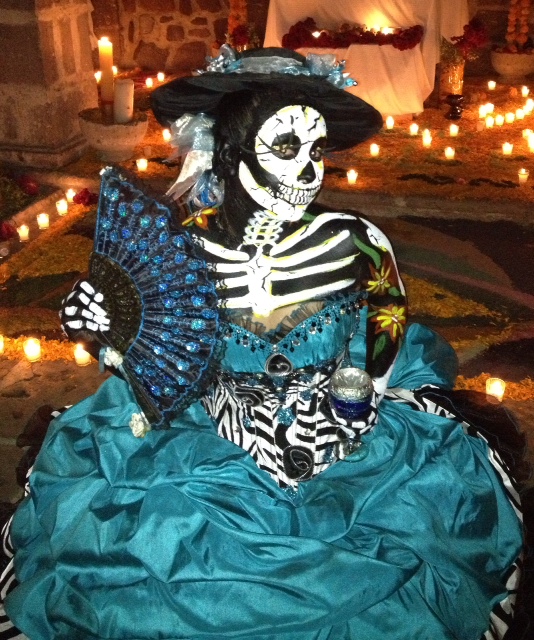
If you haven't really heard from her, la Calavera Catrina is a fancy skeleton lady who wears pretty dresses and elaborate hats (just like the first photo shows). Actually, for many years the Spanish word "catrín" has been used in Mexico to define an elegant or fancy gentleman, in the same way "catrina" is used  to call an upper-class  lady.

Her first appearance was in the famous etching called "La Calavera Garbancera" (right), created by the Mexican printmaker José Guadalupe Posada in 1913. Posada wanted to criticize some Mexicans that used to deny their roots and wished to look European and wealthy, but really belonged to a low class. He used to say: ..."en los huesos, pero con sombrero francés con sus plumas de avestruz" (in her bones, but with a French hat with ostrich feathers).

She was named "la Catrina" by the artist Diego Rivera, when long after Posada's death, he painted her in his mural "Dream of a Sunday in Alameda Park" (left). In this piece, we can see the full body of the fancy skeleton lady, accompanied by Posada.

La Catrina has become an important Mexican icon for the celebration for the Day of the Dead, and we can find her in various ornaments and artcrafts (in fact, she is so popular now that a lot of people like to dress up like her during Day of the Dead celebrations). Actually, it is common for Mexicans to buy clay Catrina figurines to decorate their homes, for that reason, the dresses and posses of this character have become more and more creative. Nowadays we find dancers, singers, musicians, sexy devils, brides, and many more.

The small town of Capula, in the state of Michoacan, Mexico, is famous for making different clay artcrafts, it's the home of great artists, and, in my opinion, the place were you can find the finest Catrinas in the country, not to mention that you don't need to spend a fortune to obtain these fine art pieces. In fact, every year before the Day of the Dead, a Catrina Fair takes place there, so you will find figurines of every shape, size, color and price (they are really cheap, unique and beautiful). Here are some pictures that I took during this year's fair:


I hope that this little post helped you to learn more about this very special Mexican character. Please, feel free to leave any comment.

Sources:

es.wikipedia.org/wiki/La_Catrina
img: artesytradicionesdemexico.com/2012/10/29/de-la-calavera-garbancera-a-la-catrina


Wednesday, October 03, 2012

Oktoberfest Ist Here!!

  The official Okotberfest 2012 poster design., Copyright Oktoberfest.de


Who would want to be in a party where you could drink the best beer in the world? I know that I definitely would!! In fact, travel to Germany during the Oktoberfest is part of my bucket list. As you can see, I haven't experienced yet, but nonetheless I wanted to do a little research and tell you some facts about this appealing tradition.

Oktoberfest takes place every year in München  (located in the south of Germany, it's the third largest city of the country) starting on the first Saturday after September 15th, it usually lasts 16 to 18 days. This year it started on September 22nd and will end on October 7th. 

The first Oktoberfest took place in 1810 to celebrate the marriage of King Ludwig I, where all the citizens were invited to attend the festivities held on the fields, specially the horse races that marked the end of the event and were the reason to continue the tradition (they stopped doing them in 1960). Since then, it has been canceled 24 times due to several reasons, including cholera epidemics and war.

In our days, the festival starts when the Mayor of München taps the first keg of beer at 12:00 o'clock. After that, visitors from all over the world can take a seat in the tents, enjoy the music, taste the food and drink the many different German beers that are offered.

The festival receives approximately 6.4 million visitors each year, who drink around 7,100,000 liters of beer in those famous big jars. Hopefully, I'll be one of them someday, and I will be able to tell you more about this cool German festivity.   

If you have more information regarding Oktoberfest or want to share your experience, please leave a comment below.

Cheers!!

Source: http://en.wikipedia.org/wiki/Oktoberfesthttp://www.oktoberfest.de/en/.

Wednesday, September 19, 2012

IT'S PHILLY, I'M IN LOVE!!


They call it 'the City of Brotherly Love', and they are not mistaken (in fact, it's the literal meaning of Philadelphia in Greek). I was there 2 weeks ago and, before my trip, I remember reading the adds in the guides and maps saying something like "hello, future Philly lover", and thinking they were exaggerating. I guess I was wrong, because now, after being there for one week, I declare myself a true Philadelphia lover.

Some of my friends give me a weird look when I say this, but I couldn't help comparing Philadelphia to my home in Mexico, Morelia. Both cities are important in the history of their countries, both have something to do with the independence, they have culture all around and they still keep that special charm  from the past in their buildings.

So let's get to some historical facts, shall we? Philadelphia was founded in 1682 by William Penn and 70 years later, it became the most important British port in America. Home of Benjamin Franklin, Thomas Jefferson, John Adams and George Washington, the city is mostly known because it was the place where the Founding Fathers discussed and signed the Declaration of Independence in 1776 and the Constitution of the United States in 1787. Also, it was the Capital of USA for 10 years before it was moved to Washington DC in 1800 (by the way, in those days the yellow fever was killing a lot of people, but nobody knew that it was caused by a mosquito bite, so they just decided to flee the city).

So, you can tell that the city is filled with interesting places to see and things to do for every taste. You can dive into history in the old city, see famous art pieces in the Museum of Art (and the famous stairs from the movie Rocky), take a stroll by the Schuylkill river, see a show in one of the many theaters of  Broad street, visit the first penitentiary or even go on a tour to hear all about spooky legends and ghost stories (there are lots of them).

On top of all, there is one thing that I felt while visiting Philly: the people who live there are very nice. Everywhere there was someone who would ask us where we were from and immediately welcomed us with a warm smile (for the record, I've always felt good and welcomed while visiting the US, but this time there was something else).

To sum up, I strongly recommend everyone to visit Philly, I can assure that you won't regret planning your next vacation to this amazing and beautiful city.


Source: my personal experience. Pics taken by Lilirog.


Saturday, September 15, 2012

PUEBLOS MÁGICOS


September knocks on our doors and I can't help talking about a Mexican subject. This is a piece that I've been meaning to write for a long time, to explain a topic that can be found in every tourism site for Mexico. I'm talking about Mexico's Magical Towns.

"Pueblos Mágicos" (Magical Towns) is a program created by SECTUR (Mexico's Department of Tourism) in 2001, with the help of the local and state governments, in order to promote the culture, history and natural beauty of several small cities and towns around Mexico.

One of the main goals of the program is to highlight the tourist value of certain places in the country. This way, the Mexican government is trying to improve the tourism offer, making it original, innovative and able to fulfill the needs of the market.

At the moment, Mexico has 56 Pueblos Mágicos located in 28 states. Each one of them represents the soul and culture of its population, enhancing their symbols, legends, history, significal events, daily life and, generally speaking, their MAGIC.

All the towns in Mexico can apply to become a Pueblo Mágico. If any place wishes to be part of the program, it has to fulfill certain characteristics which have to be evaluated by SECTUR. An annual evaluation takes place each year so the places can keep their status of magical towns.

Michoacán, the state where I live, has 5 Pueblos Mágicos: Patzcuaro, Santa Clara del Cobre, Cuitzeo, Tlalpujahua and Angangueo.

If you want to learn more and see the complete list of Pueblos Mágicos, you can go to www.sectur.gob.mx.